Start here · 7 min
Getting a reading you can trust
Almost every wrong score is a photo problem, not a maths problem. Thirty seconds of setup changes your result more than anything you can do afterwards.
Sigil measures geometry. It does not know what your face looks like in person — it knows what the photograph says, and a photograph can be wrong about a face in ways that are completely invisible to you when you take it.
That is the good news. It means a score that feels wrong is usually fixable, for free, in the time it takes to move to a window.
The one that matters most: distance
Hold a phone at arm's length and the lens is close enough that the parts of your face nearer the camera are magnified relative to the parts further away. Your nose grows. Your ears shrink. Your midface stretches. Nothing about your face changed — the projection did.
This is measured, not folklore. At a typical selfie distance the nasal base reads roughly 30% wider than the same face shot from portrait distance, and going from a short lens to a portrait lens moves facial width-to-height by a tenth of a unit or more. Those are larger than most of the differences Sigil is trying to detect.
Arm's length
The lens is ~30 cm away. Nose and forehead are magnified, ears and jaw pull back. Every width ratio on your face is now wrong in the same direction.
Two metres, zoomed in
Step back and let the camera do the framing. Rear camera at 2× if you have it. Ask someone else, or use a timer and a shelf.
The front photo

- 1
Camera at eye height
Above eye level shortens the lower third and flatters the jaw; below it does the opposite. Both move real measurements.
- 2
Level, not tilted
Your pupils should sit on a horizontal line. A head tilt reads as facial asymmetry you do not have — and asymmetry you do not recognise in your own result is the classic sign of it.
- 3
Neutral expression, lips together
A smile moves the mouth corners, the cheeks and the eye aperture at once. Whatever your face is doing is what gets measured.
- 4
Hair off the forehead
The hairline anchor is meant to sit on the skin, and hair over it pushes the whole upper third out — which then pushes the other two thirds out with it.
- 5
Glasses off, no filters
Beauty mode, skin smoothing and portrait blur all change the surface the Features pillar reads. Ears do not matter on the front photo — nothing is measured from them there.
The side photo
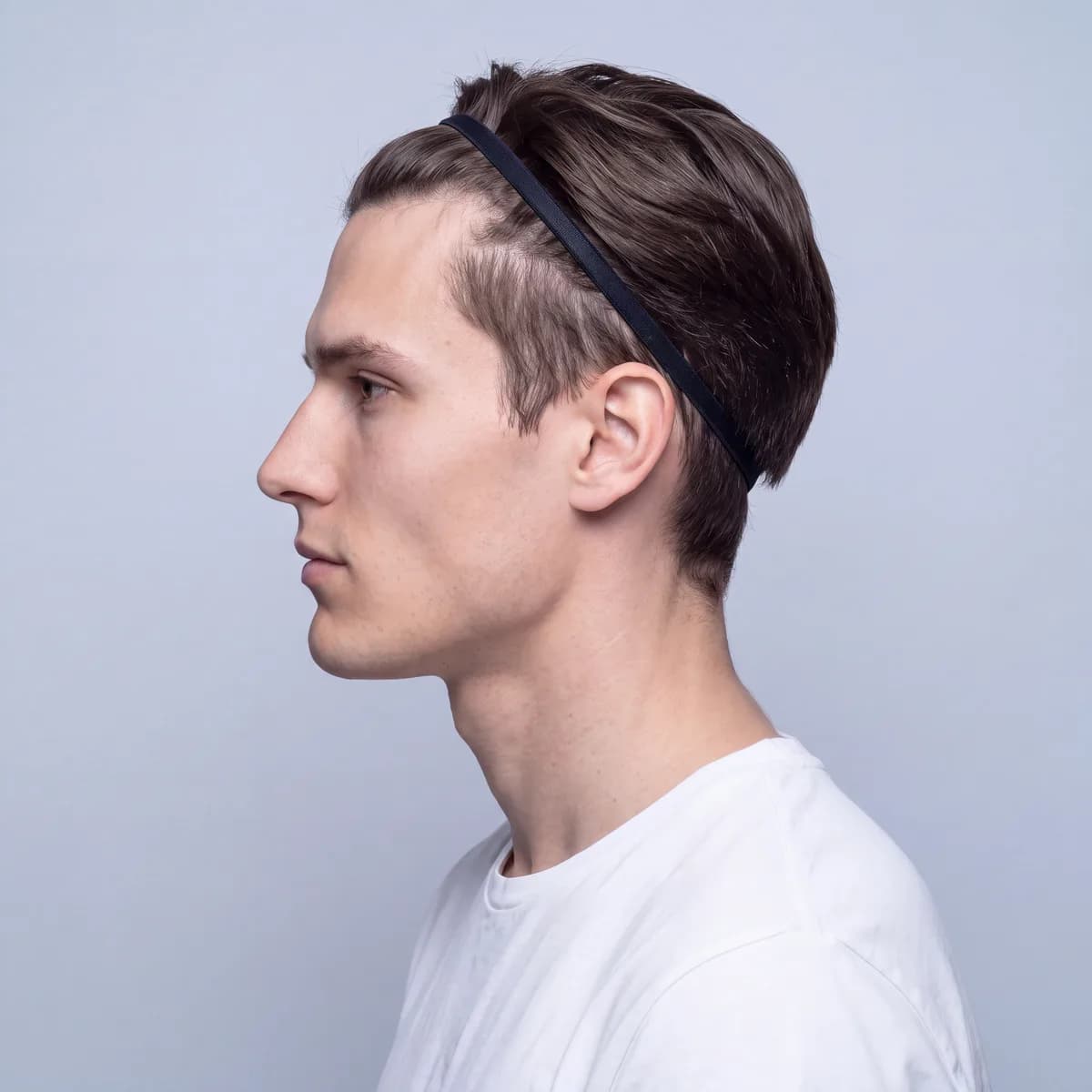
The side photo carries 23 of the 44 harmony measurements, and it is the one people get wrong most often. Two things decide whether it is usable.
A true 90°. Turn until the far eyebrow disappears. Under-turning compresses the profile and flatters projection; over-turning does the reverse.
Your ear. Every angle on the side view is measured against the Frankfort plane, the horizontal line running from the ear canal to the bottom of the eye socket. Sigil builds that line from your tragus — the small flap of cartilage in front of the ear canal. If hair covers it, the plane is a guess, and if the plane is a guess then so is every angle built on it: nasofacial, nasomental, mandibular plane, chin projection, all of them.
Keep your gaze level and straight ahead — not at the phone, which pulls your chin around — and let your jaw hang unclenched. Clenching recruits the masseter and reads as bone.
Light
One soft source, in front of you. A window in daytime is the best light most people have.
Overhead light is the trap. It carves a shadow under the cheekbone and along the jaw, and both of those read as definition — so a downlit bathroom photo can raise Angularity without a single thing about your face having changed. Backlighting does the opposite and loses the outline entirely.
If you are tracking progress
Write your setup down. Room, time of day, distance, which camera.
Real change over two months is worth a few tenths of a point. So is changing rooms. If you do not hold the setup still, you cannot tell which one you are looking at — and that is the whole value of re-scanning.
When a score still looks wrong
| What you are seeing | Usually means |
|---|---|
Everything is off in the same direction | Lens distortion — you were too close, or on the wrong camera. |
One or two measurements are wildly out, the rest are fine | A single landmark landed in the wrong place. Open the correction step and check that one. |
Asymmetry you do not recognise in the mirror | Head turn or tilt, or a one-sided point that drifted. |
The side score is far below the front | Not a true 90°, or the head was not level, or the tragus was covered. |
A vision-rated trait disagrees with you | Those are assessed, not measured. You can re-rate yourself against the same scale the model used. |